Many systems talk to each other technically, but don’t understand each other functionally. And that is precisely where the real work begins.
An ERP thinks in transactions and financial truth. A production line thinks in timing and continuity. Management wants dashboards. Security wants auditability. And the operator on the floor mostly wants his machine to still do tomorrow what it does today.
Technically you can perfectly connect those worlds. An API here, a message queue there, some JSON in between — done. That is how it looks in architecture diagrams too.
Except in practice it rarely works that way.
Middleware doesn’t only translate protocols. It translates expectations.
An ERP wants to know now whether an order has been processed. A machine on the shop floor sometimes cannot respond to that at all — not because the connection is broken, but because physical reality has a different rhythm than a transaction system. That is not a bug. That is a fundamental difference in how those two worlds look at time.
I encounter these kinds of mismatches constantly. Not as abstract architectural questions, but as very concrete problems. A control system that becomes overloaded because an IT system polls too aggressively. A message that gets rewritten three times before it arrives, and nobody knows why anymore. A temporary workaround from 2017 that has quietly become the backbone of an entire integration.
In OT/IT environments this becomes even sharper.
IT is built around consistency, authentication, and manageability. OT runs on stability, availability, and predictable behavior. A production line that stops for five seconds because a certificate needs to be renewed — that is not a small incident. That is production loss, and sometimes a safety risk.
So somewhere it must be decided what “real-time” actually means. Which errors are acceptable. Who is leading in conflicts. How long data remains valid. What happens when a system goes down. Which actions may happen automatically and which may not.
And that happens surprisingly often in middleware.
In the diagram below you see exactly that structure: at the top the IT systems with their own logic and expectations, at the bottom the OT systems with a fundamentally different rhythm — and middleware in between as the layer that translates both worlds.
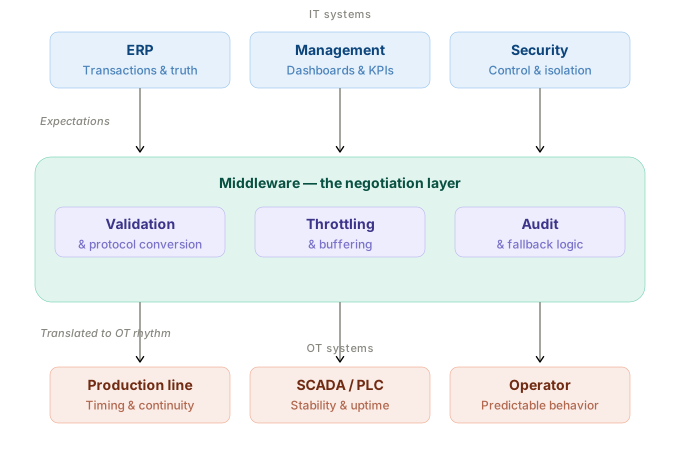
What you see there in practice:
- Validation of messages before they reach a machine.
- Protocol conversion between systems that were never intended for each other.
- Throttling to protect the OT environment from IT traffic.
- Buffering when systems run at different speeds.
- Audit logging for compliance and fallback logic for when an interface fails.
Sounds like a clean architecture. But in practice this grows organically. Under pressure, during an outage or a migration. Because a problem needs to be solved now. And that is exactly where it becomes dangerous.
Middleware: where compromises converge
Middleware quietly becomes the place where technical and organizational compromises converge. Business rules disappear into scripts. Temporary fixes become permanent. Nobody documents why a certain delay is in there, because at the moment it was built it was “just a quick fix.” Three years later it has become hidden business logic and nobody dares touch it anymore.
I say this not to judge — I have built it myself, in environments where you didn’t have the luxury of doing an architecture review first. But precisely for that reason I know: middleware demands architectural thinking. Not only technically. Also organizationally. Because ultimately it is not about data. It is about boundaries — between systems, teams, responsibilities, and realities.
Good middleware does not hide complexity. It makes it manageable.